One per pair, for the hook
Here are two cubes of the same size: one aluminium and one steel. Which has the greater mass?
Think alone for thirty seconds, then complete this sentence:
I think the ____________ cube has more mass because ________________________________
Compare with your partner, then be ready to share.
One solves, one coaches, then swap
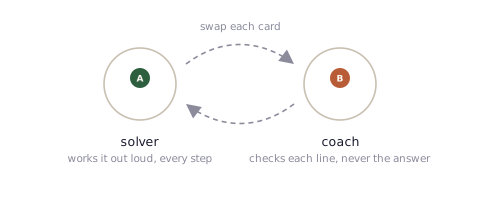
Solver
- Work one problem out loud.
- Write down every step as you go.
- State the unit in your answer.
Coach
- Watch and check each line.
- Give a tick or a hint, never the answer.
- Then swap roles for the next card.
Eight cards, building to the stretch
Partner A takes the odd numbered cards, Partner B the even, swapping the solver and coach roles each time. The set builds from direct calculations, through the rearrangements and a unit conversion, to one stretch card on comparing liquids.
A block has a mass of 240 g and a volume of 30 cm³. Find its density.
A plastic cube has a mass of 18 g and a volume of 24 cm³. Find its density.
Lead has a density of 11.3 g/cm³. Find the mass of a 5 cm³ piece.
Water has a density of 1.0 g/cm³. Find the mass of 250 cm³ of water.
An object has a mass of 60 g and a density of 2.4 g/cm³. Find its volume.
A steel part has a mass of 158 g. Steel has a density of 7.9 g/cm³. Find its volume.
Convert a density of 0.8 g/cm³ into kg/m³.
Oil (0.92 g/cm³) and water (1.0 g/cm³) do not mix. Which floats on top, and why?