The shape of the lesson
By the end of the lesson, Core learners can
- recall and use the average speed equation v = s / t, with consistent units
- read a speed from the gradient of a distance-time graph
- read an acceleration from the gradient, and a distance from the area, of a speed-time graph
- use a = Δv / Δt, and treat a deceleration as a negative acceleration
- recall that an object in free fall near the Earth accelerates at about 9.8 m/s²
- choose the right tool, a formula or a graph reading, for a given motion problem
Key vocabulary
speed, velocity, average speed, distance-time graph, speed-time graph, gradient, area, acceleration, deceleration, free fall, g. All terms are revisited from earlier lessons in the subtopic.
One journey, read every way
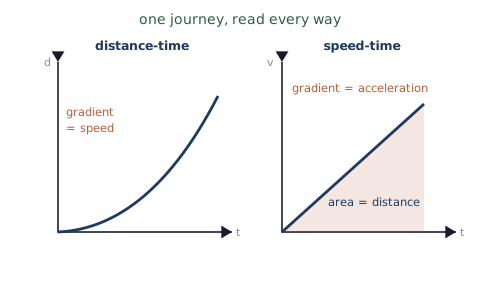
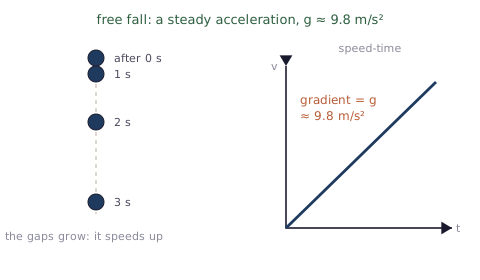
The twin-graph poster is the unit anchor: one journey drawn two ways. On the distance-time graph the gradient is the speed; on the speed-time graph the gradient is the acceleration and the area under the line is the distance; and a free-fall column reminds learners that a dropped object speeds up at about 9.8 m/s². This closing lesson reads the whole poster, so every question in the rounds and on the test maps to one part of it.
Forty-five minutes, phase by phase
| Time | Phase | What happens in the room | Grouping |
|---|---|---|---|
| 0 to 5 min | Recall: the poster | The twin-graph poster goes back up. Quick whole-class recall: distance-time gradient is the speed; speed-time gradient is the acceleration and the area is the distance; free fall is about 9.8 m/s². | Whole class |
| 5 to 25 min | Numbered Heads Together | Groups of four number off 1 to 4. The teacher poses a mixed question, groups put heads together to agree one answer every member can give, then a random number is called to answer. Six rounds across the Core thread. Full facilitation is in the activity materials. | Groups of four |
| 25 to 40 min | Apply and assess | Learners complete the short test individually (the worksheet), which mirrors the rounds: speed, both graph readings, acceleration, deceleration and free fall. | Individual |
| 40 to 45 min | Mark and reflect | Quick mark against the key (self or peer). Learners note which part of the poster each missed item belongs to. | Individual or pairs |
Warm up, then assess
Numbered Heads Together carries the warm-up and makes every learner accountable through the random call.
Protected: the short test. It is the summative check of the Core outcomes for 1.2 and is not cut.
If time is short: take Numbered Heads Together to four rounds, and keep all six test questions.
In a 60 minute block: add a final round where each group writes a one-line motion problem, swaps it with another group, and solves it.
Numbered Heads Together
Groups of four number off 1 to 4. The teacher poses a question; the group puts heads together to agree one answer that every member can give; a random number is called, and that learner answers for the group. Because nobody knows who will be called, every learner prepares every answer. A full step-by-step facilitation guide, with the six rounds, the answers, a teacher script and troubleshooting, is provided as the activity in this bundle, so it can be run faithfully.
Why it suits this lesson. This is an apply-and-assess lesson, so the goal is that every learner can do every type of question before the test. The random call makes that the group's shared responsibility, which is exactly what Numbered Heads Together is for.
What to head off, and how
| Trap learners fall into | Teaching move that pre-empts it |
|---|---|
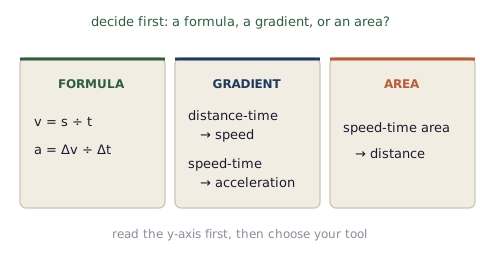
| Mixing up the two graphs. | Always read the y-axis first: distance-time gradient is the speed; speed-time gradient is the acceleration. |
| Reading an area on a distance-time graph. | The area under a distance-time graph has no useful meaning; it is the area under a speed-time graph that gives the distance. |
| Dropping or mixing units. | Keep to m/s for speed and m/s² for acceleration; convert km/h to m/s before using a value. |
| Averaging the speeds instead of using totals. | Average speed is the total distance divided by the total time, not the mean of the speeds. |
| Treating g as a force or a speed. | g is the free-fall acceleration, about 9.8 m/s². |
Support, challenge and the checks
- Support: a poster-shaped checklist (which axis? gradient or area? which formula?) so learners choose the tool before solving.
- Challenge: a two-stage journey: find a distance from a speed-time area, then use it to find an average speed.
- Language: rehearse "the gradient of a distance-time graph is the speed" and "the gradient of a speed-time graph is the acceleration".
Assessment is summative and formative. The short test is the summative check for the Core thread of 1.2. The Numbered Heads Together rounds are formative: the random call shows which question types still need work before the test, and the reflection ties each missed item back to a part of the poster.
Equipment and resources
- the Numbered Heads Together activity (with its facilitation guide) and the short test (the worksheet) from this bundle
- the twin-graph poster, displayed; mini whiteboards; a way to pick a random number (cards, dice or a spinner)
- (optional recap) the Unit 1 motion simulations at /sims/unit-1/; the student topic pages Speed and velocity, Motion graphs, Acceleration and Free fall