The shape of the lesson
By the end of the lesson, learners can
- describe projectile motion as a constant horizontal velocity combined with vertical free fall, the two being independent
- resolve a launch velocity into horizontal and vertical components
- apply constant velocity to the horizontal motion and the equations of motion to the vertical motion
- find the time of flight, the range, the maximum height and the velocity at a given instant
- describe qualitatively the effect of air resistance on the trajectory
Key vocabulary
projectile, horizontal and vertical components, independence of motions, time of flight, range, maximum height, resultant velocity, air resistance. Each term is introduced as it is first needed.
Two independent motions, one shared time
With no air resistance the only force on a projectile is its weight, so the horizontal acceleration is zero and the vertical acceleration is g downward. The horizontal and vertical motions are independent and share only the time t: a ball launched horizontally and a ball simply dropped from the same height land together.
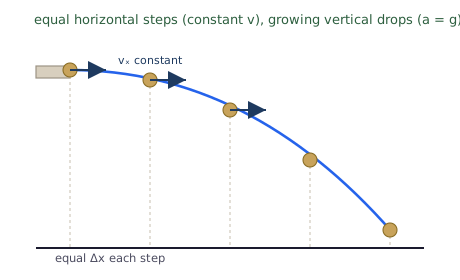
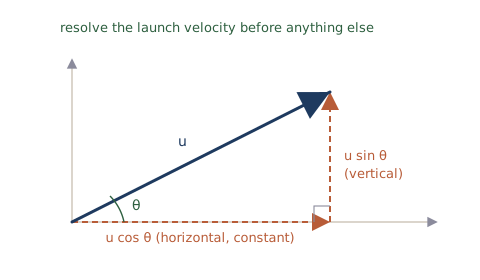
For a launch speed u at angle θ, the horizontal component u cos θ stays constant and the vertical component u sin θ changes under gravity. Solve the horizontal motion with x = (u cos θ) t and the vertical motion with the suvat equations using a = g. The vertical motion sets the time of flight and the maximum height; the range is the horizontal velocity multiplied by the time of flight.
Velocity at an instant, and air resistance
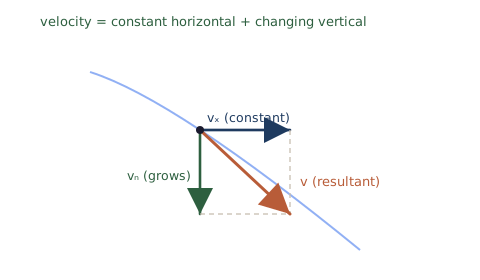
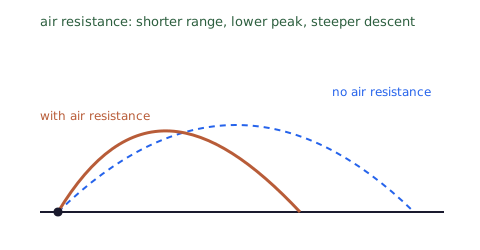
The velocity at any point is the vector sum of the constant horizontal component and the changing vertical component, so at the top of the path the velocity is not zero: the horizontal component is still present. With air resistance the range and the maximum height are reduced and the path becomes asymmetric, with a steeper descent.
Sixty minutes, phase by phase
| Time | Phase | What happens in the room | Resources |
|---|---|---|---|
| 0 to 5 min | Starter | Show a dropped ball and a horizontally launched ball landing together; ask why, and draw out the independence of the vertical motion. | Slide 1, fig-projectile-path |
| 5 to 17 min | Teach: resolve | Resolve the launch velocity; set up the horizontal and vertical motions separately. | Slides 2 to 5, fig-components |
| 17 to 30 min | Model | Work a horizontal launch and an angled launch, finding time, range and height; find a velocity at an instant. | Slides 6 to 10, fig-velocity-at-point |
| 30 to 50 min | Activity | Run Cooperative Concept Mapping; groups arrange and link the concept cards, justifying each link. | Concept card set, large paper |
| 50 to 60 min | Plenary | Compare maps; add air resistance as a final node; exit ticket. | Slide 11, fig-air-resistance-traj |
A horizontal launch and an angled launch
Example 1: a horizontal launch
A ball is thrown horizontally at 15 m s−1 from a cliff 20 m high. Take g = 9.81 m s−2. Find the time to land, the horizontal distance, and the vertical speed on landing.
Example 2: an angled launch
A projectile is launched at 25 m s−1 at 30 degrees above the horizontal over level ground. Find the components, the time of flight, the range and the maximum height.
Cooperative Concept Mapping
Projectile motion is where vectors, the equations of motion and free fall all come together, so it is an ideal point to map how the ideas connect. Each group is given a set of concept cards and a large sheet; they arrange the cards and join them with labelled arrows that state the relationship (for example splits into, is, determines, gives). Every learner must justify aloud at least one link they drew. Groups then compare maps and add air resistance as a final node. A full step-by-step facilitation guide, with the concept card set and a teacher model map, is provided as the activity in this bundle, so it can be run faithfully.
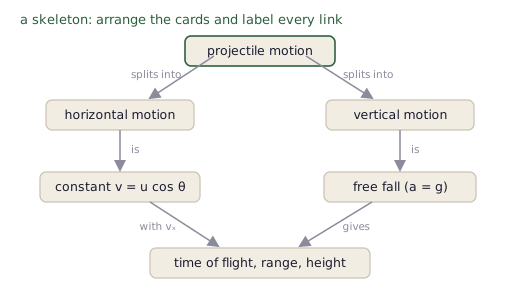
Why it suits this lesson. Mapping forces learners to make the connections between motions explicit, which is exactly where projectile understanding tends to break. Every link is owned and justified by a named learner, which gives individual accountability, and gaps in a map reveal where understanding is missing.
What to head off, and how
| Trap learners fall into | Teaching move that pre-empts it |
|---|---|
| Thinking the horizontal motion slows down. | With no air resistance the horizontal velocity stays constant; nothing acts horizontally. |
| Believing a horizontally launched ball and a dropped ball take different times to fall. | They share the same vertical motion and land together; the horizontal motion is independent. |
| Treating the launch speed as if it acts horizontally. | The speed must be resolved into components first; only u cos θ is horizontal. |
| Saying the velocity at the top of the path is zero. | The vertical component is zero there, but the horizontal component is still present. |
Support, challenge and the checks
- Support: a two-column frame, horizontal and vertical, so learners keep the two motions separate from the start.
- Challenge: find the speed and direction of the projectile at a stated time, and find where it lands when launched from a height.
- Language: rehearse the frames "horizontal: constant, x = ..." and "vertical: a = g, suvat" before learners write.
Assessment is formative. Exit ticket question 1: a stone is thrown horizontally at 8.0 m s−1 from a height of 5.0 m, find the time to land and the horizontal distance. Exit ticket question 2: explain why the horizontal velocity of a projectile does not change when air resistance is ignored. Each group's map and the links learners justified make the connections visible.
Equipment and resources
- the concept card set and large sheets, and the worksheet from this bundle
- a two-column frame for support, and the exit ticket from the final slide
- the site simulation Projectile Motion, and the student topic page Projectile motion